Pest control and exterminators in Trumbull, CT
Trumbull, CT has a larger share of homes from the 1950s and 1960s than any other town in the county, 44.3% of them, mostly detached houses with sill plates, decks and crawlspaces now well over half a century old. That is where termite and carpenter ant checks start. Outdoors, 161 Trumbull ticks reached the state lab in 2025.
Found a tick or a nest right now?
- Tick bite: save the tick. Save it dry in a sealed bag; send it to CAES for free testing through your health department or by mail. See a doctor if a rash or fever follows. Health Department, 335 White Plains Road: $5 with the form, at the counter or in the locked drop box; results by email. details about tick drop-off in Trumbull
- Nest by the door: keep back. Keep people and pets away from the nest; trouble breathing or hives all over need medical care right away.
- Droppings: air the room, then wet-clean. Air the room for 30 minutes, wear gloves and soak droppings with disinfectant or bleach before wiping; never sweep or vacuum them.
- Suspected bed bugs: report it. Renters tell the landlord, who has five business days to inspect; homeowners ask a DEEP-registered pest control company to inspect.
Hiring an exterminator in Trumbull
- Check its DEEP registration.
- Get products, labels and notices in writing.
- Compare two written quotes.
- Trumbull ticks can go in the Health Department's drop box at 335 White Plains Road: a bagged tick, the form and $5; staff empty it daily.
Pest control services in Trumbull
In Trumbull, the tick route stays in town. Bag the tick that bit you, fill in the town’s tick form and take both, with $5, to the Health Department on White Plains Road, or leave them in the locked drop box by the front door after hours. Staff empty the box daily and forward the tick to CAES, the state’s Agricultural Experiment Station in New Haven, which emails a result within two weeks. Jot down the bite date and whether it followed yard work, a hike or a ballfield.
Indoors, Trumbull’s housing sets the agenda. Before buying a house from the town’s postwar building boom, ask for a wood destroying insect inspection and read the sellers’ disclosure, which under CGS 20-327b asks about termite, insect, rodent or pest infestation problems. For a winged swarm inside in spring, save a few insects in a jar; the shape of the antennae and waist tells termites from ants.
Whatever the problem, paid pesticide work in Connecticut takes a state-certified applicator at a firm registered with the Department of Energy and Environmental Protection (DEEP), and under section 22a-66c that firm’s registration number must appear on its contracts, its trucks and its print and directory advertising. Nothing here is for sale, and no firm is booked or endorsed; the about page describes who researches this guide. A Trumbull note goes with each pest guide:
- Wood destroying insect inspections for Trumbull buyers and termite treatment for Trumbull foundations and sill plates: the median Trumbull home dates from 1965, and 39.0% were built before 1960.
- Carpenter ants in Trumbull porches, decks and window sills: a colony means wet wood somewhere, and a separate page on how carpenter ant and termite swarmers differ helps sort a jar of winged insects.
- Tick control for Trumbull yards: 84.3% of Trumbull homes are detached houses, and the town’s own tick page suggests wood-chip barriers between lawns and wooded areas.
- Mouse control for Trumbull houses and garages: according to DEEP, house mice spend most of their lives in fields and only sometimes move into buildings; older foundations and utility openings are where they get in.
- Wasp and hornet nests around Trumbull houses: no town data; a few yellowjackets indoors in autumn can point to a colony inside a wall cavity, per CAES’s yellowjacket guidance.
- Stink bugs and other fall invaders in Trumbull: the brown marmorated stink bug, which CAES confirmed in Connecticut in 2010, does not bite or sting; UConn Extension says it enters through attic vents, cracks, chimneys and under siding in the fall.
- Bed bugs in Trumbull rentals: only 10.3% of occupied homes are rented, but the state’s bed bug statute applies to each rented apartment, condo or attached unit.
- Cockroach control in Trumbull kitchens and basements: no town record; CAES’s cockroach guidance places the Oriental cockroach in cellars and crawl spaces, which postwar houses often have.
- Commercial pest control for Trumbull restaurants and shops: the Health Department’s inspectors check food establishments, daycares and public pools.
- Spotted lanternflies in Trumbull: a countywide pest since CAES recorded the first one here in 2020; in fall, CAES says, adults gather in large groups on tree-of-heaven.
Nearby towns: Shelton, across the town line to the east, whose ticks go through a regional health district; Bridgeport, to the south, with a 1955 median build year; Fairfield, to the southwest, which also charges $5 to forward a tick; and Westport, which sent CAES 277 ticks in 2025.
Costs, choosing a company and rentals
Average treatment for a standard infestation (national): $171 (This Old House, March 2026).
Pest calendar
| Pest | Peak months | January | February | March | April | May | June | July | August | September | October (this month) | November | December |
|---|---|---|---|---|---|---|---|---|---|---|---|---|---|
| Blacklegged tick nymphs, 1 | May–Jul | none reported | none reported | none reported | none reported | peak | peak | peak | active | active | none reported | none reported | none reported |
| Blacklegged tick adults, 1 | Mar–Apr, Oct–Nov | active | active | peak | peak | active | none reported | none reported | none reported | none reported | peak | peak | active |
| Mosquitoes (West Nile virus risk), 2 | Jul–Sep | none reported | none reported | none reported | none reported | none reported | active | peak | peak | peak | active | none reported | none reported |
- Peak: the busiest months
- Active
- None reported
- October (this month)
Why pests in Trumbull trace back to postwar houses
What do Trumbull’s 1950s and 1960s houses mean for termites?
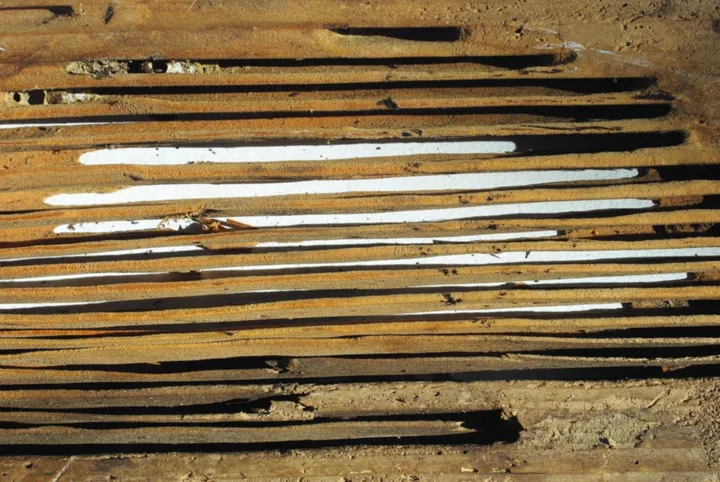
Mostly a reason to inspect, not to panic. Census construction-decade counts date 22.6% of Trumbull homes to the 1950s and 21.8% to the 1960s, together the largest postwar share in the county, ahead of Weston and Fairfield. CAES’s eastern subterranean termite sheet calls it the termite most frequently encountered in New England and describes the evidence: sandy tubes about as wide as a pencil, and timber that seems sound outside yet rings hollow when knocked, with no sawdust. Because a colony excavates only about a square foot each year, CAES says no hasty decision is needed and recommends talking to several firms first. At a sale, lenders using FHA or VA loans accept the NPMA-33 report, which records a visual look at accessible areas and is expressly not a structural damage report.
Why do carpenter ants show up in older Trumbull houses?
Because they nest in water-damaged wood, and an older house has had longer to collect leaks. CAES’s carpenter ant fact sheet says the ants “cannot excavate undamaged wood”, and that finding them in a house “is evidence that there may be water-damaged wood in the structure”. In a Trumbull house of 1965, the median year built per the Census median, that points to window sills, porch and deck attachments, chimneys, and the floor around tubs and toilets, all nest sites the sheet names. Signs include sawdust piles below the nest and scratching in walls at night. A full-grown colony numbers around 2,000 workers and needs three to six years to reach that size. The sheet’s fixes start with the structure: repair the leak, replace wet wood, and ventilate crawl spaces, attics and basements.

Why did more Trumbull ticks test positive for Lyme in 2025?
Statewide, more ticks did. Trumbull’s share rose from 21% of 95 tested ticks in 2024, in CAES’s 2024 results, to 35% of 113 in 2025, in its 2025 results. Over the same two years, Connecticut’s share went from 27.4% to 36.9%, so Trumbull moved roughly in step with the state rather than standing out. The lab tests what bitten residents decide to send, not a field sample, and the 2025 Trumbull share sits just under the statewide figure. What did stand out was volume: 161 ticks, the eighth-most of the 23 towns, which says Trumbull residents use their Health Department’s service. The other infections in Trumbull’s 2025 ticks were Babesia in 11, Anaplasma in 7 and Borrelia miyamotoi in 6.
How do mice get into a Trumbull house in the fall?
Through the small gaps an older house collects. House mice “normally live outdoors in fields, occasionally migrating into structures”, DEEP’s page on managing rats and mice explains, and a Norway rat needs a hole of only half an inch. Since 84.3% of Trumbull homes are detached, by Census building-type figures, most owners control their whole foundation, and DEEP’s checklist is practical. Make basement windows tight. Close cracks and openings where pipes, conduit, drains and vents pass, using steel wool, cement, sheet-metal flashing or quarter-inch hardware cloth. Cut shrubs back from the foundation, and keep anything stored outdoors at least 18 inches off the ground and a foot from walls and fences. Snap traps set along walls catch mice. Poison baits carry a catch, DEEP warns: a mouse can die where nobody can reach it.
Where does a Trumbull renter turn about pests?
To the landlord in writing, then to the town. Only 10.3% of Trumbull’s occupied homes are rented, per Census owner and renter figures, but the town has a Fair Rent Commission whose ordinance gives tenants real leverage. If a complaint alleges conditions that break a housing, health or building code, the commission notifies the right town office, and after a hearing it can find that housing “fails to meet State/Local health and safety requirements, and order the suspension of rent payments until the standards are met”. It also enforces the state’s ban on retaliating against tenants who ask for repairs. Bed bugs have their own statute, section 47a-7a: once told, a landlord has five business days to inspect and bears the cost of inspection and treatment.
Ticks and mosquitoes in Trumbull
The CAES lab identified 161 Trumbull blacklegged ticks in 2025, against 126 the year before. It tested 113 of them and found the Lyme bacterium in 40 (35%), with no Powassan virus, per its 2025 tick report; in 2024, 20 of 95 (21%) were positive, per its 2024 tick report. Because Trumbull belongs to no health district, its row also holds the ticks the town forwards. Illness is tallied by region instead of town; for the Greater Bridgeport planning region, which includes Trumbull, CDC’s public Lyme case data count 184 cases in 2023.
Mosquitoes are trapped at one Trumbull site, Cranbury Drive. None of the 982 tested from it in 2025 carried a virus, the closing 2025 report shows. This summer West Nile virus appeared in 2 samples out of 818 mosquitoes, one caught August 13 and one August 25, according to the cumulative 2026 results. CAES’s trapping brochure names July to September as the riskiest months for people. For a side-by-side look, the tick season guide ranks all 23 towns, and its town-by-town CSV can be downloaded.
Exterminator prices and registration checks for Trumbull
What will a termite check or treatment cost on a Trumbull house?
Only national figures exist; no publisher prices Trumbull or Connecticut. Bob Vila’s survey puts a termite or other wood-destroying insect inspection at $100 to $290 and termite treatment at $230 to $940 (national data, as of September 2024). This Old House has termites at $250 to $1,000 (national data, as of March 2026). Fixr’s estimate for subterranean termites is $7 to $14 per linear foot of treated area (national data, as of January 2025), so have the foundation’s length written into the quote. Other pests are priced in the Connecticut cost guide.
Which DEEP certification should a Trumbull termite or tick company hold?
It depends on the job. In DEEP’s list of certification categories, termites, powder post beetles and structure-damaging carpenter ants fall under 7B Termites & WDO Pest Control, while yard tick work falls under 3A Ornamental & Turf. Section 22a-66f requires every business location to keep a supervisor certified in each category of work it takes on, so a firm doing both jobs needs both. Anyone can confirm the firm’s registration and the supervisor’s certificate through DEEP’s online look-up.
Offices to call in Trumbull
- Trumbull Health Department: 335 White Plains Road, Trumbull, CT 06611; 203-452-1030; Monday to Friday 8:30 am to 4:00 pm. Public health emergencies: 203-261-3665.
- Tick testing through the town: tick sealed in a plastic bag, the town form and $5, left at the counter or in the locked box at the front entrance; tape disqualifies a tick. Emailed results follow within two weeks, the town’s tick testing page says, and the $5 charge is on the department’s fee schedule.
- Trumbull Fair Rent Commission: tenant complaints about rent increases, code conditions and retaliation; its page links the ordinance and a fair housing request form.
- State tick lab in New Haven: skips the $5 if you mail the tick yourself, and its packing and eligibility rules are online. Visitors from Monroe or Easton can find their own health office in the state’s directory of local health agencies.
Sources
- Year structure built, ACS 5-year 2024, table B25034 (Census Bureau)
- Pesticide control statutes, CGS chapter 441 (Connecticut General Assembly)
- Spotted lanternfly in Connecticut (CAES)
- Residential property condition disclosure, CGS chapter 392 (Connecticut General Assembly)
- Yellowjackets, Vespidae (CAES fact sheet)
- New agricultural pest confirmed, December 2, 2010 (CAES press release on the stink bug)
- What is that brown bug in my house? (UConn Extension, 2020)
- Cockroaches, Blattodea (CAES fact sheet)
- Health inspections and licensing (Town of Trumbull)
- Eastern subterranean termite, Reticulitermes (CAES fact sheet)
- Wood destroying insect inspection report NPMA-33 (hosted by HUD)
- Carpenter ants, Camponotus (CAES fact sheet)
- Median year structure built, ACS 5-year 2024, table B25035 (Census Bureau)
- Tick testing results for 2024, Trumbull line (CAES)
- Tick testing results for 2025, Trumbull line (CAES)
- Rodent management (Connecticut DEEP)
- Units in structure, ACS 5-year 2024, table B25024 (Census Bureau)
- Tenure, ACS 5-year 2024, table B25003 (Census Bureau)
- Fair Rent Commission (Town of Trumbull)
- Ordinance establishing the Fair Rent Commission (Town of Trumbull)
- Landlord and tenant statutes, CGS chapter 830 (Connecticut General Assembly)
- Lyme disease aggregated public-use data with geography (CDC)
- Mosquito trap sites 2020 to 2026, Cranbury Drive TR66 (CAES)
- Mosquito testing, 2025 season final (CAES)
- Mosquito testing, 2026 season through October 13 (CAES)
- Mosquito trapping brochure, July 2025 (CAES)
- Pest control cost survey, national (Bob Vila)
- Pest control pricing, national (This Old House)
- Exterminator pricing, national (Fixr)
- Supervisory certification categories (Connecticut DEEP)
- Pesticide information look-up (Connecticut DEEP)
- Health Department hours and contacts (Town of Trumbull)
- Tick testing (Town of Trumbull)
- Health Department fee schedule (Town of Trumbull)
- Submitting a tick for testing (CAES)
- Find your local health agency (Connecticut DPH)
Frequently asked questions
Are there stink bugs in Connecticut?
Yes. The brown marmorated stink bug was confirmed here by CAES on December 2, 2010, after residents of Darien, Norwalk and six other towns sent in single specimens. It neither bites nor stings. Each fall it hunts for a winter shelter, squeezing in by attic vents, chimneys and gaps under siding, which older Trumbull houses have plenty of.
When do termites swarm in Connecticut?
Mostly between March and June, the CAES fact sheet on eastern subterranean termites says, and never in summer or fall. Winged insects indoors later in the summer are not these termites; carpenter ants keep swarming into summer and fall. In a Trumbull house from the 1950s or 1960s, look at the sill plate and any wood in contact with soil.
Where do I take a tick in Trumbull, CT?
The town Health Department at 335 White Plains Road handles it. Put the tick in a sealed plastic bag, complete the submission form and add $5; ticks on tape are not tested. After hours, use the locked box beside the front entrance, which staff check daily. Expect an emailed result within two weeks.
Did Trumbull mosquitoes test positive for West Nile virus in 2026?
Yes. The CAES trap on Cranbury Drive had West Nile virus in 2 samples by October 13, from mosquitoes caught August 13 and August 25, after a negative 2025. A sample is a pooled batch of mosquitoes, so two positives show the virus circulating near the trap, not how many people are sick.