Termite control in Fairfield County, CT
Termite control in Fairfield County starts with finding eastern subterranean termites, which swarm March to June. Then a certified applicator treats the soil or baits the colony. CAES says damage “progresses slowly,” about one square foot of wood a year per colony. So there is time to get several opinions before you choose a treatment.
Termites in Connecticut: the eastern subterranean termite
The CAES fact sheet on the eastern subterranean termite calls it “the most-frequently encountered termite species in New England.” It lives in colonies deep in the soil, most of them in wooded areas with no contact with buildings at all. Workers tunnel up to feed on wood that touches or sits close to the soil.
Two facts set termites apart from other wood pests:
- They eat sound wood. Unlike carpenter ants, which “only excavate previously water-damaged wood,” termites “can destroy undamaged wood.”
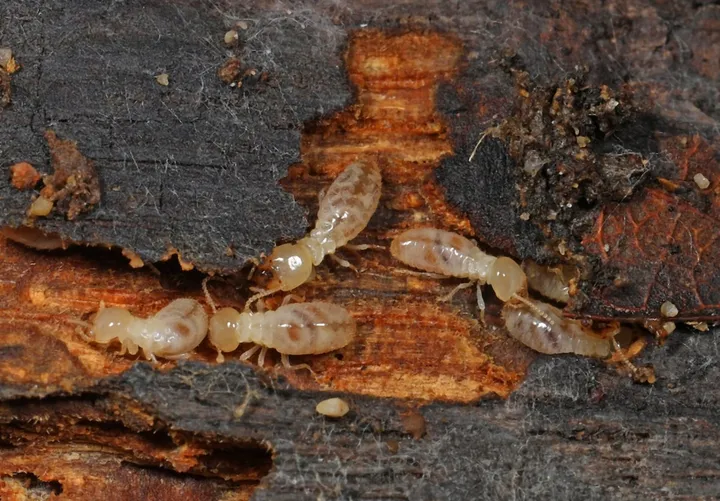
- They hide. Workers are pale, blind and soft-bodied, and cannot survive open air. They live underground or inside the wood they are eating, and travel over stone or concrete inside mud tubes.

Pest calendar
| Pest | Peak months | January | February | March | April | May | June | July | August | September | October (this month) | November | December |
|---|---|---|---|---|---|---|---|---|---|---|---|---|---|
| Termite swarms, 1 | Mar–Jun | none reported | none reported | peak | peak | peak | peak | none reported | none reported | none reported | none reported | none reported | none reported |
- Peak: the busiest months
- Active
- None reported
- October (this month)
What are the signs of termites?
Swarmers in spring
The winged reproductives, or swarmers, are often the first sign. They are dark brown or black and are “often mistaken for flying ants.” CAES says they swarm in spring, “usually March – June, but occasionally on warm winter days as early as January.” They “do not swarm in the summer or fall.” A swarm of winged insects indoors in October is very unlikely to be termites.
Termite or ant?
CAES gives three ways to separate a termite swarmer from a flying ant:
| Feature | Termite | Ant |
|---|---|---|
| Antennae | Straight, “beaded” | Smooth, “elbowed” |
| Body | Broad, no narrow waist | Distinct narrow waist |
| Wings | Paddle-shaped, both pairs equal in length | Forewings longer than hindwings |
Collect a few in a sealed bag or jar to show an inspector. The carpenter ants vs termites guide goes further.
Mud tubes and hollow wood
- Shelter tubes. “Pencil-sized sandlike tubes” running up foundation walls, piers or other exposed surfaces suggest current or past activity.
- Hollow wood. Damaged wood “will appear intact externally but will sound hollow if tapped,” because the feeding galleries follow the grain inside.
- No sawdust. “There is no sawdust or powder associated with termite feeding.” Galleries are lined with a mix of soil, feces and saliva. Carpenter ants, by contrast, leave clean galleries and “ant dumps” of speckled sawdust and debris.
How are termites treated?
CAES says that once termites are identified, help from a pest management professional “is strongly suggested.” It also says the professional and the homeowner should agree a clear plan before treatment. That plan “may include direct soil injections of termiticides, baits, or barrier treatments around foundations.”
In plain terms:
- Soil treatment. A termiticide is put into the soil at the foundation, where termites travel from the ground to the wood. Ask whether it means drilling through a slab, porch or finished floor.
- Baits. Stations placed around the house that termites feed on. Ask how often the stations are checked and for how long.
- Barrier treatments around the foundation, alone or combined with the above.
Liquid treatment or bait stations?
EPA’s termite page names “conventional barrier treatments and termite baits” as the two common forms of treatment. Here is how the sources describe each.
| Liquid soil-applied termiticide | Termite bait system | |
|---|---|---|
| How it works | A termiticide “specifically labeled for that use” is applied to the soil as a barrier, per EPA | “Cellulose baits that contain a slow-acting insecticide,” per EPA |
| Where it goes | Into the soil around the perimeter and, on a slab, “through the slab in areas where evidence occurs,” per Fixr | Stations around the house; EPA describes one bait ingredient as part of “a termite inspection, monitoring, and baiting system” |
| How common | “The most common technique for treating termite infestations,” per EPA | Introduced “to help reduce the overall use of insecticides,” per EPA |
| The main caution | Done improperly, it “can cause contamination of the home and surrounding drinking water wells and will not protect against termites,” per EPA | Depends on the stations being checked; ask how often and for how many years |
| Published national price | $7 to $14 per linear foot for subterranean termites (Fixr, national, as of January 2025) | This guide found no published figure |
Both appear in the CAES fact sheet list of options, “direct soil injections of termiticides, baits, or barrier treatments around foundations,” and some plans combine them. EPA adds that termiticides “must demonstrate the ability to provide structural protection” before they are registered. It also says: “In most cases, termiticide application can only be properly performed by a trained pest management professional.” If your house is on a private well, say so before any soil treatment is planned.
Ask the applicator which approach they recommend for your house and why. Ask how long before you should see results, and what the warranty or service agreement covers. Ask for the product’s label information in writing too. Before it agrees to apply a pesticide, Connecticut requires the company to give you the label details (Connecticut General Statutes, chapter 441). They include the product name, EPA registration number, active ingredients, signal word, precautions and reentry information.
Tented fumigation exists and is the most expensive treatment method on This Old House’s cost page. The CAES fact sheet, though, does not list it among the options for subterranean termites. If someone proposes it, ask why soil treatment or baiting would not work.
What kills termites permanently?
No treatment lasts forever, so plan on follow-up. EPA names two common approaches: a soil-applied barrier of a termiticide “specifically labeled for that use,” and bait systems built on “cellulose baits that contain a slow-acting insecticide.” The active ingredients on EPA’s list of the most common in conventional termiticides include bifenthrin, fipronil and imidacloprid. University of Kentucky entomologist Michael Potter’s homeowner guide says “All liquid termiticides are supposed to control termites for at least five years when applied according to label directions.” How long one lasts depends on the product, the care taken and how many termites are around. He adds: “It is a bit of a gamble to purchase any termite treatment without an ongoing service agreement.”
Is termite treatment worth it?
For a confirmed infestation in the house, the extension sources say yes. Potter’s guide says winged termites indoors “almost always” indicate “an infestation warranting treatment.” A termite report “is normally a condition of sale,” so an untreated colony tends to surface when you sell. The NPMA-33 guidelines below say treatment “should be recommended” where there is evidence and no record of an earlier treatment. What is not worth it is paying in a hurry. Potter says an extra day, week or month to decide “generally is inconsequential.” And swarmers from a stump or woodpile in the yard “do not automatically mean the house is infested.”
Don’t rush the decision
This is the most useful point in the CAES fact sheet. Termite damage “progresses slowly,” and “Immediate or hasty action is not required. A termite colony excavates an average of one square foot of wood per year.” CAES warns that hiring the first available company can lead to “an overly costly or inefficient treatment,” and recommends interviewing several. In its words, a consistent story “will start to emerge” that exposes misleading claims, and “Extremely high or low quotes should then be discarded.”
Why not do it yourself?
CAES says self-treating termites “is not suggested, because it is time-consuming, expensive, and ineffective.” There is a second reason, for anyone who may sell: “homeowner-applied treatments will not satisfy the requirements of a home inspection, should a home be later offered for sale.” See the termite inspection guide for what buyers and lenders look for.
Can I buy a professional termiticide and apply it myself?
You can buy termite products, but buying one does not make the job a homeowner job. Michael Potter’s homeowner guide says a typical treatment “may involve hundreds of gallons” of termiticide. It goes into the ground along the foundation, beneath slabs and within foundation walls, using masonry drills, large spray tanks and soil-injection rods. Potter says do-it-yourself products, “sold to homeowners at retail stores or bought over the internet, will seldom eradicate an existing termite problem.” Connecticut requires no certificate to use a general-use product on your own home. A restricted use product needs a certificate or a certified supervisor (CGS 22a-47 and 22a-54). Either way, EPA says “the label is the law” (EPA).
How do you prevent termites?
CAES’s prevention steps target the three things termites need: wood, moisture and a way in.
Food
- Keep firewood, lumber, brush and wood debris away from the foundation and crawl spaces.
- Raise stored wood at least 6 inches off the soil on stone or concrete.
- Use mulch sparingly against the foundation, and keep it off siding and wooden parts of the house.
Moisture
- Make sure downspouts carry water away from the foundation.
- Don’t let lawn sprinklers spray the foundation.
- Keep plants and ground cover at least 3 feet from the foundation for air flow.
A dry foundation helps indoors as well: damp basements are where camel crickets, silverfish and house centipedes gather.
Access
- Don’t install foam board insulation below grade; termites tunnel through soft materials.
- Separate wooden porches and decks from the house with metal flashing.
- Don’t let climbing plants grow on the house.
Regular inspection matters too: the CAES fact sheet calls inspecting a building for termites or damage “important.” Look at the foundation, sill and crawl space for mud tubes, and probe any wood that sounds hollow.
Do termites eat pressure-treated wood?
They can get into it, so treated lumber is not a reason to skip inspections. The University of Kentucky’s guide to protecting a home against termites says: “Contrary to popular belief, pressure-treated wood is still vulnerable to termite attack; termites often enter the wood through cracks and cut ends, or build tunnels over the surface.” Treated deck posts, sills and stair stringers that touch soil still give termites a route. EPA’s prevention advice for building is a concrete foundation, an air space between soil and wood, and covering exposed wood with “a sealant or metal barrier.” The CAES steps above, keeping wood off the soil and the foundation dry, apply to treated wood too.
Damage, repairs and paperwork
Treatment stops termites; it does not fix damaged wood. The industry’s standard inspection form, the NPMA-33 Wood Destroying Insect Inspection Report, says plainly that it “is not a structural damage report.” The inspector’s training does not cover damage evaluation. Where damage is found, it recommends contacting “a qualified structural professional” to judge the extent and the repairs. The same applies after a treatment: a contractor or engineer, not the pest company, should decide whether a sill or joist needs replacing.
Keep every record of the treatment: the date, the company’s DEEP registration number, the products used, the areas treated and any warranty. The NPMA-33 form’s guidelines cover a house with signs of termites and no record of earlier treatment. There, treatment “should be recommended” even if no live termites are seen. A documented past treatment can change that recommendation when you sell.
The form also lists the conditions that invite wood destroying insects, and they overlap with CAES’s list. They include earth-to-wood contact, foam insulation touching soil, poor grading and drainage, and poor ventilation or moisture. Firewood, wood mulch and tree branches against the house count too, as do wood debris in the crawl space, landscape timbers and decaying wood.
Connecticut rules for termite work
- Certification category. DEEP’s certification category descriptions list category 7B, Termites and WDO (wood destroying organisms) Pest Control, covering “termites, powder post beetles, dry rot and other wood destroying organisms.” Each place of business must employ a supervisor certified in each category it works in.
- Business registration. Every pesticide application business needs a DEEP registration and must print the number on contracts, vehicles and ads (chapter 441, section 22a-66c). Ask for it.
- Neonicotinoids. From October 1, 2027, Connecticut limits neonicotinoid pesticides. The ban does not apply to “indoor or structural pest control” (Public Act 25-33), so termite treatments are not affected.
- No “safe” claims. EPA treats claims that a pesticide is “safe” as false or misleading (40 CFR 156.10). Ask for the label instead.
How much does termite treatment cost?
The national cost guides price termite work in different ways, so each is shown on its own row with its date and never averaged. No published source gives a Connecticut or Fairfield County termite price.
| What is priced | Figure | Source |
|---|---|---|
| Termite treatment | $250 to $1,000 | This Old House, national, as of March 2026 |
| Tented fumigation | $1,500 to $8,000 | This Old House, national, as of March 2026 |
| Termite treatment | $230 to $940 | Bob Vila, national, as of September 2024 |
| Subterranean termites | $7 to $14 per linear foot of the treatment area | Fixr, national, as of January 2025 |
| Drywood termite fumigation | $1,570 to $2,857 | Fixr, national, as of January 2025 |
What does termite treatment cost for a 2,000 sq ft house?
Fixr is the only one of the three guides with a termite figure for that size. For “termites and bed bugs–expect to pay as much as $3,360 to treat a 2,000-square-foot home” (national, as of January 2025). This Old House’s home-size table puts pest control for a 2,000 sq ft home at $350 to $600 (national data, as of March 2026). That table is for pest control in general, not termites. Because Fixr prices subterranean termite work per linear foot, the length of the foundation matters more than the floor area. For termites, the quote usually depends on:
- The method. Soil treatment, a bait system with ongoing monitoring, or both.
- The foundation. How many linear feet need treating, and whether slabs, porches or a finished basement must be drilled.
- Access. Crawl spaces, additions and covered areas take more work.
- The warranty or service agreement, and whether it renews each year at extra cost.
CAES’s own advice on quotes is worth repeating: get several, and discard the extremely high and low ones. The Connecticut pest control cost guide collects the sourced national ranges for other pests.
How to choose a termite company
- Check the paperwork. A DEEP registration number on the contract, and a supervisor certified in category 7B.
- Interview more than one. CAES recommends it, and it is the best defense against both overselling and underpricing.
- Ask what they found and where. Mud tubes, damaged wood or swarmers, with photos.
- Ask which method and why. Soil treatment, baits or both, and how they will know it worked.
- Read the warranty. What it covers (retreatment, repairs or neither), how long it lasts and what renewal costs.
- Get the label information for every product before you agree, as the law requires.
This guide does not recommend or rank companies.
Termites and housing age in five Fairfield County towns
No agency tracks termites town by town, so this section gives the age of each town’s housing, which buyers and owners often ask about. All figures are from the Census Bureau’s American Community Survey, 2020–2024.
- Darien has some of the oldest housing in the county: median year built 1956, with 56.4% of homes built before 1960. See pest control in Darien.
- Fairfield has a median year built of 1960; 51.1% of homes predate 1960 and 77.5% are detached single-family houses. See pests in Fairfield.
- Greenwich has 25.6% of its homes built before 1940. See pest control in Greenwich.
- Danbury has the second-newest housing of the 10 towns with pages in this guide, with a median year built of 1975; only Shelton’s, 1977, is newer. Newer does not mean termite-free; check the foundation and sill all the same. See pests in Danbury.
- Trumbull is the county’s postwar town: 44.3% of its homes went up between 1950 and 1969, a larger share than in any other of the 23 towns, with a median year built of 1965. Wood sills and decks of that age deserve a look before any treatment. See Trumbull’s 1950s and 1960s houses.
Age alone does not mean termites. What matters is what CAES lists: wood touching soil, moisture at the foundation and hidden access points. If what you found turns out to be ants, see carpenter ant control.
Sources
- CAES, Eastern subterranean termite fact sheet: https://portal.ct.gov/-/media/CAES/DOCUMENTS/Publications/Fact_Sheets/Entomology/Eastern_Subterranean_Termite_Reticulitermes.pdf
- CAES, Carpenter ants fact sheet: https://portal.ct.gov/-/media/caes/documents/publications/fact_sheets/entomology/carpenter_ants_camponotus.pdf
- CT DEEP, commercial applicator certification category descriptions: https://portal.ct.gov/-/media/deep/pesticides/certification/supervisor/catinfopdf.pdf
- Connecticut General Statutes, chapter 441: https://www.cga.ct.gov/current/pub/chap_441.htm
- Connecticut Public Act 25-33: https://www.cga.ct.gov/2025/ACT/PA/PDF/2025PA-00033-R00SB-00009-PA.PDF
- eCFR, 40 CFR 156.10: https://www.ecfr.gov/current/title-40/part-156/section-156.10
- National Pest Management Association, NPMA-33 Wood Destroying Insect Inspection Report (hosted by HUD): https://www.hud.gov/sites/dfiles/OCHCO/documents/NPMA33.pdf
- This Old House, pest control cost (national, updated March 2026): https://www.thisoldhouse.com/pest-control/pest-control-cost
- US Census Bureau, ACS 2020–2024 table B25034 (year structure built): https://data.census.gov/api/access/data/table?id=ACSDT5Y2024.B25034&g=040XX00US09$0600000
- US Census Bureau, ACS 2020–2024 table B25035 (median year built): https://data.census.gov/api/access/data/table?id=ACSDT5Y2024.B25035&g=040XX00US09$0600000
- US Census Bureau, ACS 2020–2024 table B25024 (units in structure): https://data.census.gov/api/access/data/table?id=ACSDT5Y2024.B25024&g=040XX00US09$0600000
- University of Kentucky Entomology, ENTFACT-604, Termite Control: Answers for Homeowners (Michael F. Potter, revised March 2026): https://entomology.ca.uky.edu/ef604
- EPA, Introduction to Pesticide Labels (last updated June 2, 2026): https://www.epa.gov/pesticide-labels/introduction-pesticide-labels
- University of Kentucky Entomology, ENTFACT-605, Protecting your Home Against Termites (Michael F. Potter, revised March 2026): https://entomology.ca.uky.edu/ef605
- EPA, Termites: How to Identify and Control Them (last updated October 8, 2026): https://www.epa.gov/safepestcontrol/termites-how-identify-and-control-them
- Bob Vila, How Much Does Pest Control Cost? (national, updated September 5, 2024): https://www.bobvila.com/articles/pest-control-cost/
- Fixr, How Much Does It Cost To Hire An Exterminator? (national, updated January 31, 2025): https://www.fixr.com/costs/pest-control
Frequently asked questions
How much is a termite treatment for a 2000 sq ft house?
One national guide gives a figure for that size. Fixr says termites or bed bugs can cost as much as $3,360 to treat a 2,000-square-foot home. It prices subterranean termite work at $7 to $14 per linear foot (both as of January 2025). This Old House puts termite treatment at $250 to $1,000 (national, as of March 2026).
Will regular pest control kill termites?
Not reliably. EPA says products that only claim to kill termites have not shown they protect a structure. A product whose label lacks directions to control termites and protect the structure should not be used for that. Termite work needs a termiticide labeled for it, applied by a certified applicator.
Is your house ruined if you have termites?
Usually not. CAES says termite damage "progresses slowly." A colony excavates an average of one square foot of wood a year, so "Immediate or hasty action is not required." Get several professional opinions. If damage is found, have a structural professional judge the repairs.
When do termites swarm in Connecticut?
In spring. CAES says eastern subterranean termites swarm "usually March – June," and now and then on warm winter days as early as January. They "do not swarm in the summer or fall." Winged insects swarming indoors in autumn are more likely ants. CAES says carpenter ants swarm from late spring through the summer into fall.
How can I tell termites from flying ants?
CAES gives three checks. Termites have straight, beaded antennae; ants have elbowed ones. Termites have a broad body; ants have a narrow waist. Termite wings are equal in length; an ant's forewings are longer than its hindwings. Save a few in a sealed bag for the inspector.
Can I treat termites myself?
CAES advises against it. Its fact sheet says self-treating is "time-consuming, expensive, and ineffective," and that homeowner-applied treatments "will not satisfy the requirements of a home inspection" if you later sell. It strongly suggests a pest management professional once termites are identified.