Carpenter ants vs termites in CT: how to tell them apart
Termite swarmers have straight antennae, no waist and four equal wings, and in Connecticut they swarm in spring, usually March to June. Carpenter ants have elbowed antennae, a pinched waist and longer front wings, and swarm from late spring to midsummer. Both point to moisture: carpenter ants in a house usually mean water-damaged wood.
The difference matters because the two need different work. Termites eat sound wood, and CAES strongly suggests a pest management professional for them; carpenter ants usually mean a leak to fix as well as a colony to treat. This guide draws on two Connecticut Agricultural Experiment Station (CAES) fact sheets, one for each insect.
Pest calendar
| Pest | Peak months | January | February | March | April | May | June | July | August | September | October (this month) | November | December |
|---|---|---|---|---|---|---|---|---|---|---|---|---|---|
| Termite swarms, 1 | Mar–Jun | none reported | none reported | peak | peak | peak | peak | none reported | none reported | none reported | none reported | none reported | none reported |
| Carpenter ants, 2 | Apr–Jun | none reported | none reported | none reported | peak | peak | peak | active | active | active | active | none reported | none reported |
- Peak: the busiest months
- Active
- None reported
- October (this month)
Flying ants vs termites: how to tell them apart
Check the antennae, the waist and the wings. A flying termite has straight antennae, a thick body with no waist and two pairs of wings of the same length. A flying ant has bent (“elbowed”) antennae, a pinched waist and front wings longer than its back wings.
The winged insects that appear indoors in spring are the usual first sign, and they are easy to confuse. The CAES termite fact sheet says termite swarmers “are dark brown or black and are often mistaken for flying ants.” Both CAES sheets use the same three tests.
| Feature | Termite swarmer | Ant swarmer |
|---|---|---|
| Antennae | Straight and “beaded” | “Elbowed” |
| Body | Broad, with no narrow waist | Distinct narrow waist |
| Wings | Both pairs the same length | Front wings longer than the back wings |
| Swarm season in Connecticut | Spring only, usually March to June | Late spring into summer |
Size helps too: the CAES carpenter ant fact sheet gives winged carpenter ants as 1/2 to 3/4 inch long, and workers as 1/4 to 1/2 inch.
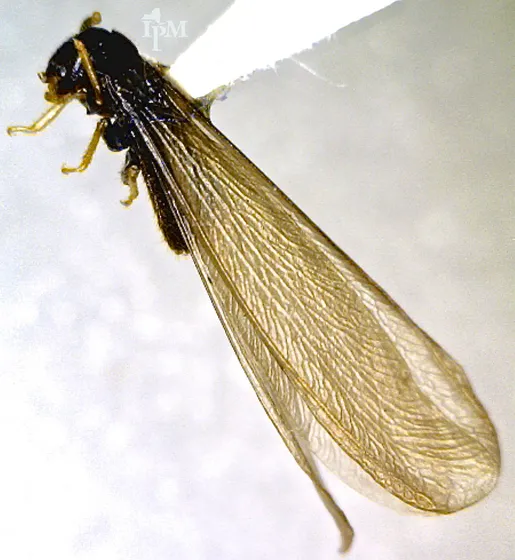
When does each swarm in Connecticut?
Termites swarm “in the spring, usually March – June, but occasionally on warm winter days as early as January,” the CAES termite sheet says, and they “do not swarm in the summer or fall.” The species here is the eastern subterranean termite, which CAES calls the “most frequently encountered termite species in New England.”
Carpenter ants swarm later. The CAES carpenter ant sheet says carpenter ant “Swarming and mating occur from late spring to midsummer,” and, comparing ants in general with termites, that “termites swarm only in the spring, while ants swarm from late spring through the summer into fall.” Worker ants are most active on spring and early-summer evenings, which is the best time to follow them back to a nest.
So the calendar is a rough guide. Winged insects in May or June could be either; winged insects in August are not termites. Insects crowding onto the house in late September and October may be something else: stink bugs and other fall invaders looking for a place to spend the winter.
What does the damage look like?
The damage differs as much as the insects do.
Termites eat the wood. The termite sheet says damaged wood “will appear intact externally but will sound hollow if tapped,” because the galleries follow the grain inside. “There is no sawdust or powder associated with termite feeding.” The galleries are lined with a mix of soil and saliva, the same material as their “pencil-sized” shelter tubes, and those mud tubes on a foundation wall “may suggest current or previous termite activity.”
Carpenter ants excavate but don’t eat wood. Their galleries are clean, with no mud lining, and “only extend to where water damage has occurred,” the termite sheet says. To keep the nest clean they push out “ant dumps,” piles of “speckled sawdust mixed with debris.” The carpenter ant sheet adds that “Nocturnal scratching noises in walls or voids may indicate a nest,” and that workers forage from 65 feet up to 100 yards from the nest, mostly at night, so the ants in a kitchen may live in a deck outside.
Why do both point to moisture?
Because both need wet conditions, in different ways.
Carpenter ants depend on it. The carpenter ant sheet says “Carpenter ants create nests by hollowing out water-damaged wood,” that “unlike termites, carpenter ants cannot excavate undamaged wood,” and that when they are found in a house, “it is evidence that there may be water-damaged wood in the structure.” The usual places are where porches, chimneys, garages and decks attach to the house, behind bathroom tile and flooring around tubs and toilets, and around window frames and sills. Outdoors, queens “usually establish nests in moist locations but may use cavities that are structurally sound and dry,” so a colony is a reason to look for a leak, not proof of one.
Termites can destroy sound wood, but the termite sheet says they “need high levels of moisture to thrive.” Its prevention steps are mostly about water and wood near the ground:
- Make sure downspouts carry water away from the foundation, and don’t let sprinklers spray the foundation.
- Keep plants and ground cover at least 3 feet from the foundation.
- Keep wood at least 6 inches above the soil, and use mulch sparingly, away from siding.
- Don’t install foam board insulation below grade, and separate wooden porches and decks from the house with metal flashing.
The same damp conditions draw damp-basement pests like silverfish and camel crickets, so a musty basement is worth fixing for more than one reason.
The carpenter ant sheet’s structural fixes overlap: repair leaking gutters, chimney flashing and damaged shingles, replace water-damaged wood, regrade soil to stop wood-to-soil contact, and ventilate crawl spaces, attics and basements. Treating the ants without fixing the leak leaves the wet wood for the next colony. Fixing the water damage may be a separate job from treating the ants.
Is your house ruined if you have termites?
No. The CAES termite sheet is direct about it: termite damage “progresses slowly. Immediate or hasty action is not required. A termite colony excavates an average of one square foot of wood per year.” It warns that hiring the first available company “may result in an overly costly or inefficient treatment,” and suggests interviewing several professionals, after which “Extremely high or low quotes should then be discarded.”
What CAES does not suggest is doing it yourself. Self-treating termites “is not suggested, because it is time-consuming, expensive, and ineffective,” and “homeowner-applied treatments will not satisfy the requirements of a home inspection, should a home be later offered for sale.” The termite control guide explains the treatment options a company may offer, and the pest control cost guide has the national price ranges.
Carpenter ants are less urgent still in most cases. A mature colony of about 2,000 ants takes “three to six years to mature,” the CAES carpenter ant sheet says, and it adds that “Baiting ants is most effective during the spring.” The carpenter ant guide covers finding the nest and the control options.
What if you’re buying or selling a house?
A wood destroying insect report covers both insects. The NPMA-33 form, hosted by HUD and approved for FHA and VA loans, lists the insects it covers as “termites, carpenter ants, carpenter bees, and reinfesting wood boring beetles.” It is a visual inspection of accessible areas, and “not a structural damage report.”
Connecticut’s seller disclosure asks about both problems. The residential condition report in CGS 20-327b includes “Termite, Insect, Rodent or Pest Infestation problems?” and “Rot or Water damage problems?” A seller has to answer from what they actually know, but isn’t required to order inspections. The termite inspection guide covers the report in detail.
Who does the work in Connecticut?
DEEP’s certification category descriptions put both insects in one category: 7B, Termites & WDO Pest Control, covers “termites, powder post beetles, dry rot and other wood destroying organisms,” including carpenter ants affecting a structure. Ask which supervisor holds 7B, and look for the company’s DEEP registration number on the contract, which CGS 22a-66c requires. The FAQ shows how to look up a registration.
Older houses in the towns this guide covers
None of the sources here links housing age to termites or carpenter ants, but an older house is worth a careful look. By the Census Bureau’s year-built table, the median home in Bridgeport was built in 1955, in Darien in 1956 and in the town of Fairfield in 1960, the three oldest medians of the 10 towns with pages in this guide. Each town page covers its own housing: pest control in Bridgeport, pests in Darien and pest control in Fairfield. For pests in Greenwich, the age figure to know is that 25.6% of homes were built before 1940, by the Census Bureau’s age-of-housing counts.
Sources
- CAES, Eastern subterranean termite fact sheet: https://portal.ct.gov/-/media/CAES/DOCUMENTS/Publications/Fact_Sheets/Entomology/Eastern_Subterranean_Termite_Reticulitermes.pdf
- CAES, Carpenter ants fact sheet: https://portal.ct.gov/-/media/caes/documents/publications/fact_sheets/entomology/carpenter_ants_camponotus.pdf
- HUD, NPMA-33 Wood Destroying Insect Inspection Report: https://www.hud.gov/sites/dfiles/OCHCO/documents/NPMA33.pdf
- Connecticut General Statutes, chapter 392 (sections 20-327b to 20-327e): https://www.cga.ct.gov/current/pub/chap_392.htm
- CT DEEP, commercial applicator certification category descriptions: https://portal.ct.gov/-/media/deep/pesticides/certification/supervisor/catinfopdf.pdf
- Connecticut General Statutes, chapter 441 (section 22a-66c): https://www.cga.ct.gov/current/pub/chap_441.htm
- US Census Bureau, ACS 2020-2024 median year structure built (B25035): https://data.census.gov/api/access/data/table?id=ACSDT5Y2024.B25035&g=040XX00US09$0600000
- US Census Bureau, ACS 2020-2024 year structure built (B25034): https://data.census.gov/api/access/data/table?id=ACSDT5Y2024.B25034&g=040XX00US09$0600000
Frequently asked questions
How can you tell a flying ant from a termite?
Look at three things, according to CAES. Termite swarmers have straight, beaded antennae, a broad body with no waist and wings of equal length. Ants have elbowed antennae, a narrow waist and front wings longer than the back ones. Termite swarmers are dark brown or black and often mistaken for flying ants.
When do termites swarm in Connecticut?
In spring, usually March to June, according to the CAES fact sheet on the eastern subterranean termite, the most common termite in New England, and occasionally on warm winter days as early as January. Termites do not swarm in summer or fall, so winged insects in August are more likely ants.
Is your house ruined if you have termites?
No. CAES says termite damage progresses slowly and immediate or hasty action is not required: a colony excavates an average of one square foot of wood per year. That leaves time to get several inspections and quotes. CAES also says self-treating termites is not suggested and won't satisfy a home inspection when you sell.
Do carpenter ants mean water damage?
Often. CAES says carpenter ants hollow out water-damaged wood and cannot excavate undamaged wood, so a colony inside a house is evidence that there may be water-damaged wood in the structure. Outdoors, queens usually pick moist spots but may use dry, sound cavities, so check before assuming rot.
Who treats carpenter ants and termites in Connecticut?
A pest control company whose supervisor is certified in DEEP's category 7B, Termites and Wood Destroying Organisms, which covers termites and carpenter ants affecting a structure. The business also needs a DEEP registration number, printed on its contract and ads.