Cockroach control in Fairfield County, CT
Four cockroach species invade homes in the Northeast, CAES says, and the small German cockroach of kitchens and bathrooms can reach adulthood in six weeks. Control in Fairfield County starts with food, water, clutter and sealed cracks, then baits. A certified applicator can reach wall voids and other spots that home products miss.
German cockroaches and other roaches in Connecticut homes
The Connecticut Agricultural Experiment Station’s cockroach fact sheet says that of an estimated 4,000 cockroach species, “only about a dozen” are true pests of buildings. Four “are recognized as regular home invaders in the northeast”:
| Species | Size and look | Where it lives |
|---|---|---|
| German cockroach | About 1/2 inch, light brown, two dark stripes behind the head | “Warm and humid areas, such as kitchens and bathrooms” |
| American cockroach | About 1 1/2 inches, reddish-brown, the largest in the Northeast | Very warm places; more often in “restaurants, bakeries, and grocery stores than private homes” |
| Oriental cockroach | 1 to 1 1/4 inches, very dark brown | Cooler, moist places “such as cellars and crawl spaces” |
| Brown-banded cockroach | About 1/2 inch, two yellow-brown bands across the body | Warm spots near “objects producing ambient heat” |
The German cockroach is the kitchen and bathroom species, and the fastest to multiply of the four. CAES says it is not native to the Americas; it comes from northeastern Africa and southeast Asia. Adults are small, oval and light brown, with “two distinctive black longitudinal stripes behind the head.” Females carry their egg case until it is ready to hatch, and “thirty to 50 nymphs can hatch from one ootheca.” In good conditions nymphs reach adulthood in six weeks. “Indoors, cockroaches are capable of developing year-round,” CAES says, so there is no off-season for an indoor infestation.
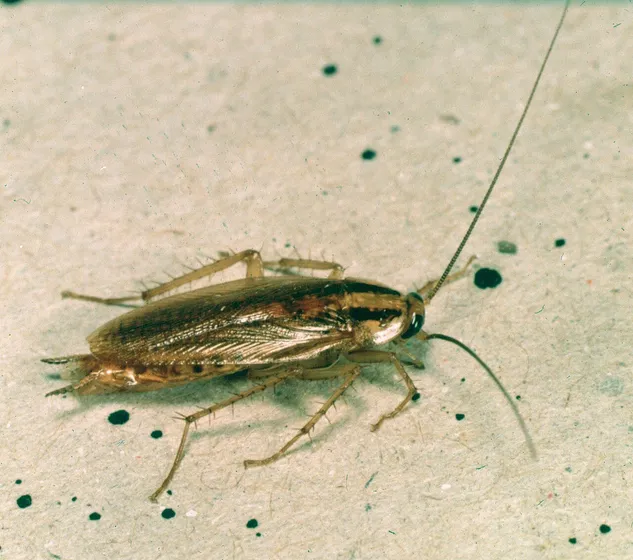

The other species grow more slowly. CAES says American cockroach nymphs take 7 to 12 months to develop, Oriental cockroach nymphs 9 months to 2 years, and brown-banded nymphs about 5 months.
Roaches that wander in but do not infest
Two outdoor cockroaches cause a lot of worry and need little action:
- Wood roaches (Parcoblatta, 12 species) are native forest insects. Winged males, about 3/4 inch and golden brown, sometimes wander into homes in summer, often bathrooms, drawn by humidity and night lights. CAES says they “do not infest homes or reproduce indoors” and do not need extermination; well-fitted windows and intact screens keep them out.
- The spotted Mediterranean cockroach is small, pale and brown-spotted, and “has become more frequently reported in Connecticut since 2010,” CAES says. Home invasions are infrequent and it does not breed indoors. Exclusion is the answer here too.
If you see one large roach in July in a house near the woods and no others, it may be one of these. Catch it and compare it to the fact sheet before paying for treatment.
A fast, many-legged insect in a damp basement is more often a house centipede, and a small silvery one is likely a silverfish; the guide to house centipedes, silverfish and camel crickets shows how to tell them from roaches.
Are cockroaches a health risk?
CAES lists three concerns. Cockroaches can contaminate “food and preparation surfaces by walking over them,” some give off an unpleasant odor, and “certain allergic reactions may be triggered by repeated exposure to cockroach residue.” That is reason enough to deal with an infestation early, without alarm.
How do you know if you have cockroaches?
- Live roaches, especially at night when the kitchen light goes on; most cockroaches are nocturnal and prefer dark places.
- Egg cases, which CAES describes as “hard bean-shaped” capsules; American and Oriental cockroaches leave theirs behind, while German females carry them.
- Shed skins from nymphs, which molt several times as they grow.
- An unpleasant odor; CAES says some cockroaches give one off.
Check under sinks, behind the refrigerator and stove, around dishwashers, in cabinet hinges and wherever pipes come through walls.
Prevention: food, water, warmth and shelter
CAES says the success of an infestation depends on “food availability, shelter, warmth, and water,” and that “resolving or eliminating these factors greatly reduces the risk of large-scale infestation.” Its steps:
Food. Cockroaches eat almost anything, including “book binding glue, paper, and insect remains.” Store food in the refrigerator or airtight containers. Wash dishes, pots, pans and pet bowls right after use and don’t leave pet food out overnight. Wipe counters and food areas, and empty and clean trash and recycling bins often.
Moisture. Repair or replace leaking pipes, fix standing water, and run a dehumidifier in humid spaces such as basements.
Shelter. Cut clutter, and “caulk or seal openings around pipe entrance points and cracks or holes in walls to prevent access.”
How can I get rid of roaches? First steps this week
Before calling anyone, a week of these steps from the CAES fact sheet shows whether the problem is small or established:
- Identify the roach. Compare a specimen with the table above. A wood roach in a bathroom in July is a screen problem, not an infestation.
- Cut off food overnight. Put everything in the refrigerator or sealed containers, wash dishes and pet bowls before bed, and take out the trash.
- Dry things out. Fix drips under sinks, wipe up standing water and run a dehumidifier in a damp basement, where Oriental cockroaches favor cool, moist spots.
- Seal the obvious gaps around pipes and in cracked walls with caulk.
- Use baits, not sprays, in the kitchen. Boric acid baits placed where roaches travel, following the label; CAES advises against aerosols near or on food storage and preparation areas.
If you still see roaches every night after that, or you rent and see them in common areas, it is time for an inspection.
What a certified applicator does
CAES says home products “should always be used in tandem with the above prevention and sanitation practices.” “Boric acid baits are a commonly available solution,” and “aerosol pesticide applications are not recommended near or on areas that food is stored or prepared.”
When an infestation is hard to control, CAES says a pest management professional may be needed. Professionals “have access to a wider variety of control methods and equipment that can deliver treatments to hard to reach areas such as wall voids.” A good plan should include:
- An inspection of kitchens, bathrooms, utility rooms and the paths between units, to find where roaches hide and how many there are.
- Sanitation and sealing advice in writing, because treatment fails if food, water and gaps stay as they were.
- Targeted treatment: baits in cracks and crevices and, where needed, products delivered into wall voids, not broadcast spraying over counters.
- Follow-up visits to check traps or monitors and retreat where roaches persist.
- Coordination in multifamily buildings, so neighboring units are inspected and treated together.
Does an exterminator spray every room?
Usually not, and a careful one should not. Michael Potter’s cockroach guide for the University of Kentucky says the emphasis “should be on finding and treating preferred harborage locations.” That means not “randomly spraying baseboards, countertops and other exposed surfaces.” For German cockroaches, the hiding places are mostly in kitchens and bathrooms: under sinks and toilets, behind the refrigerator, stove and dishwasher, and inside cabinets. Treatment can reach other rooms when roaches are there. The guide says large German roach populations turn up in bedrooms and closets, and brown-banded roaches are “often found in rooms other than kitchens and bathrooms.” It says the technician “should perform a thorough inspection on each service visit.”
How do I prepare for a cockroach treatment?
Ask the company for written prep steps before the visit, and follow them. A sample German cockroach checklist from the City of Albuquerque’s Environmental Health Department shows what they usually cover. Empty kitchen and bathroom cabinets and pantry shelves, and cover what you took out. Vacuum crumbs, including under the stove and refrigerator. Clean the surfaces and report any leaks under sinks. Pick up pet dishes and cover fish tanks. The checklist also says not to treat on your own with store-bought pesticides, which “can interfere with the process of the pest control operator.” For when you can go back in, follow the reentry time on the product label.
Ask for the product labels before work starts and the reentry times afterward. No pesticide is described as safe in this guide; EPA treats safety claims on pesticide labeling as false or misleading (40 CFR 156.10).
Connecticut rules that apply
Certification. Anyone applying pesticides for hire needs a DEEP certificate, and the business needs a DEEP registration number shown on written contracts, vehicles and newspaper, billboard and directory ads (Connecticut General Statutes, chapter 441). DEEP’s certification category descriptions put cockroaches in category 7A, General Pest Control, “in residential and commercial locations.”
Notice before treatment. Before agreeing to apply a pesticide, the company must give the label information to the person who asked for it and to “the resident or manager of the property to be treated” (CGS 22a-66a, in chapter 441). That includes active ingredients, signal word, precautionary statements and reentry information. In a rental, that means the tenant as well as the landlord.
Landlords. This guide found no cockroach-specific rental law in Connecticut like the bed bug statute. The general landlord duties in CGS 47a-7 apply. Landlords must comply with housing codes “materially affecting health and safety” and “do whatever is necessary to put and keep the premises in a fit and habitable condition.” They must “keep all common areas of the premises in a clean and safe condition,” maintain plumbing and sanitary facilities, and provide garbage receptacles and arrange removal. Where a town code sets a stricter duty, the stricter rule wins. A tenant with roaches should write to the landlord, keep a copy, and contact the town’s housing code or health office if the problem is not addressed.
Food businesses. Restaurants and other food establishments have their own pest rules under the state food code; see the commercial pest control guide.
How much does a cockroach exterminator cost?
Three national cost guides publish figures that apply. Each is shown on its own row with its date and never averaged. This guide found no Connecticut or town figure.
| What is priced | Figure | Source |
|---|---|---|
| Cockroaches | $100 to $600 | This Old House, national, as of March 2026 |
| One pest control visit | $50 to $500, national average $171 | This Old House, national, as of March 2026 |
| Cockroaches | $100 to $400 | Bob Vila, national, as of September 2024 |
| Common household insect, one-time treatment | $158 to $288 | Fixr, national, as of January 2025 |
| Quarterly pest control visit | $98 to $178 | Fixr, national, as of January 2025 |
Quotes rise with the number of units and rooms, the size of the infestation and the number of follow-up visits. A standing contract is not always needed once roaches are gone. Potter’s guide says many professional cockroach products “remain effective for months.” Once an infestation is eliminated, “there is seldom a need to reapply them month after month.” See the guide to pest control costs in Connecticut for other national ranges.
How to choose a cockroach company
- Check the paperwork: a DEEP registration number on the contract and a supervisor certified in category 7A.
- Ask for an inspection first, and for the species, since it tells you where they live and breed: German cockroaches in warm kitchens, Oriental cockroaches in cool, damp cellars.
- Ask what you must do: cleanup, sealing and preparation belong in the plan.
- Ask about baits and wall voids versus general spraying.
- Ask how many follow-up visits are included, and what happens if roaches persist.
- In a multifamily building, ask about neighboring units.
- Be wary of “safe” claims.
This guide does not recommend or rank companies.
Cockroaches in four Fairfield County towns
This guide found no town-level cockroach data. What the Census does show is how much of each city’s housing is in shared buildings, where the landlord duties above and building-wide treatment come into play. Figures are from the Census Bureau’s American Community Survey, 2020–2024, table B25024 (units in structure) and table B25035 (median year built).
- Bridgeport has the fewest detached single-family homes of the 10 towns this guide covers, 27.0%, and the oldest housing of the county’s 23 towns, with a median year built of 1955. Rental-property violations go to the city’s Housing and Commercial Code Enforcement office. See pest control in Bridgeport.
- Stamford: only 33.8% of housing units are detached houses. See pests in Stamford.
- Danbury: 41.0% are detached. The city’s Housing Program lets a tenant request an inspection of their rental unit if the landlord fails to respond. See pests in Danbury.
- Norwalk: 45.4% are detached. See pest control in Norwalk.
Apartment pests often come together. See bed bug inspection and treatment and mouse and rodent control.
Sources
- CAES, Cockroaches (Order Blattodea) fact sheet: https://portal.ct.gov/-/media/caes/documents/publications/fact_sheets/entomology/cockroaches_blattodea.pdf
- eCFR, 40 CFR 156.10: https://www.ecfr.gov/current/title-40/part-156/section-156.10
- Connecticut General Statutes, chapter 441: https://www.cga.ct.gov/current/pub/chap_441.htm
- City of Albuquerque Environmental Health Department, Sample German Cockroach Treatment Preparation Checklist: https://www.cabq.gov/environmentalhealth/documents/sample-german-cockroach-treatment-preparation-checklist.pdf
- CT DEEP, commercial applicator certification category descriptions: https://portal.ct.gov/-/media/deep/pesticides/certification/supervisor/catinfopdf.pdf
- Connecticut General Statutes, chapter 830 (section 47a-7): https://www.cga.ct.gov/current/pub/chap_830.htm
- This Old House, pest control cost (national, updated March 2026): https://www.thisoldhouse.com/pest-control/pest-control-cost
- Bob Vila, How Much Does Pest Control Cost? (national, updated September 5, 2024): https://www.bobvila.com/articles/pest-control-cost/
- Fixr, How Much Does It Cost To Hire An Exterminator? (national, updated January 31, 2025): https://www.fixr.com/costs/pest-control
- University of Kentucky Entomology, ENTFACT-614, Cockroach Elimination in Homes and Apartments (Michael F. Potter, revised March 2026): https://entomology.ca.uky.edu/ef614
- US Census Bureau, ACS 2020–2024 table B25024 (units in structure): https://data.census.gov/api/access/data/table?id=ACSDT5Y2024.B25024&g=040XX00US09$0600000
- US Census Bureau, ACS 2020–2024 table B25035 (median year structure built): https://data.census.gov/api/access/data/table?id=ACSDT5Y2024.B25035&g=040XX00US09$0600000
- City of Bridgeport, Housing and Commercial Code Enforcement: https://www.bridgeportct.gov/government/departments/housing-code
- City of Danbury, Housing Program: https://www.danbury-ct.gov/219/Housing-Program
Frequently asked questions
Are cockroaches common in Connecticut?
Four species are regular home invaders in the Northeast, according to CAES: the German, American, Oriental and brown-banded cockroaches. This guide found no Connecticut count of infestations. Two outdoor roaches also wander into Connecticut homes in summer, wood roaches and the spotted Mediterranean cockroach, and neither breeds indoors.
What kind of cockroach is in my kitchen?
If it is small, it is probably the German cockroach. CAES describes it as about half an inch long, light brown, with two dark stripes behind the head, living in warm, humid kitchens and bathrooms. A much larger reddish-brown roach about 1.5 inches long is the American cockroach, which CAES says is more common in restaurants, bakeries and grocery stores.
How much does a cockroach exterminator cost?
This Old House puts cockroach treatment at $100 to $600 (national data, as of March 2026). This guide found no Connecticut figure. The number of units, how widespread the infestation is and how many follow-up visits are included drive the quote.
Does my landlord have to get rid of cockroaches in Connecticut?
This guide found no cockroach-specific rental law like the bed bug law. CGS 47a-7 requires landlords to keep the premises "in a fit and habitable condition," keep common areas clean and safe, maintain plumbing and provide garbage receptacles. Ask in writing, and contact your town's housing code or health office if nothing happens.
Are cockroaches a health risk?
They can be. CAES says cockroaches can contaminate food and preparation surfaces by walking over them, and that allergic reactions may be triggered by repeated exposure to cockroach residue. That is a reason to clean up droppings and keep food sealed, and to fix the conditions that let a population grow.
Why do I see cockroaches in the summer near the woods?
Those are probably wood roaches. CAES says these native roaches live in forests, the winged males sometimes wander indoors in summer, often into bathrooms with a night light, and they do not infest homes or reproduce indoors. Tight window screens keep them out; they do not need extermination.