Termite inspection in Fairfield County, CT: what's checked and home-sale rules
A termite inspection in Fairfield County is a visual check for wood destroying insects in accessible areas. The “termite letter” lenders ask for is usually this NPMA-33 report, a form FHA and VA accept. It is no guarantee or structural report and is good for 90 days at closing; FHA, VA or lender rules decide if you need one.
Does your loan need a termite letter?
FHA loans
HUD’s FHA reference guide requires a wood destroying insect inspection only in five cases. They are evidence of active infestation; a lender requirement; a state or local law requiring it; an inspection being “customary to the area”; or evidence of decay or suspicious damage.
VA loans
VA’s Circular 26-22-11 (June 2022) makes a wood destroying pest inspection report a Minimum Property Requirement for some properties. It applies “for certain properties located in an area on the Termite Infestation Probability Map where the probability of termite infestation is ‘very heavy’ or ‘moderate to heavy.’” When it applies, the VA Notice of Value is conditioned on the report, and repairs the report requires “must be completed prior to guaranty.”
This guide could not find a VA or HUD source that states which map zone Fairfield County falls in. So it does not say whether a VA loan here requires the report. Ask your VA lender at the start; the Notice of Value will say.
The same circular lets veterans be charged the inspection fee where the Notice of Value requires it, and pay for required repairs. It says veterans “are encouraged to negotiate the cost of the wood destroying pest inspection and repairs with the seller.”
Conventional loans and cash sales
For other loans, the lender sets the rule, and a purchase contract may make an inspection a condition of the sale. A cash buyer, or a buyer whose lender does not require one, can still order an inspection. The CAES termite fact sheet notes that termite-damaged wood “will appear intact externally,” which is the case for having someone trained look.
Pest calendar
| Pest | Peak months | January | February | March | April | May | June | July | August | September | October (this month) | November | December |
|---|---|---|---|---|---|---|---|---|---|---|---|---|---|
| Termite swarms, 1 | Mar–Jun | none reported | none reported | peak | peak | peak | peak | none reported | none reported | none reported | none reported | none reported | none reported |
- Peak: the busiest months
- Active
- None reported
- October (this month)
What is a termite inspection?
The formal name is a wood destroying insect (WDI) inspection. The standard report is the NPMA-33 Wood Destroying Insect Inspection Report, published by the National Pest Management Association and hosted by HUD. The form says it “is approved for FHA and VA loans.”
For the purposes of the form, wood destroying insects are “termites, carpenter ants, carpenter bees, and reinfesting wood boring beetles.” The inspection “does not include mold, mildew or noninsect wood destroying organisms,” so rot from water damage is outside it, even though rot and carpenter ants often go together.
Does a termite inspection check for powderpost beetles?
Yes, as part of the beetles the form covers. The NPMA-33 includes “reinfesting wood boring beetles,” and the University of Kentucky’s powderpost beetle fact sheet says anobiid powderpost beetles can re-infest wood “year after year.” It calls powderpost beetles “second only to termites in their ability to damage dry, seasoned wood.” The sign is small, round “shot holes” with flour-like powder below them. Powder “the color of freshly sawed wood” points to an active infestation; yellowed or caked powder is “probably old.” The sheet adds that infestations “often die out of their own accord” and “There is no need to act immediately.” DEEP puts “powder post beetles” in category 7B with termites (category descriptions).
In Fairfield County the termite in question is the eastern subterranean termite, which CAES calls “the most-frequently encountered termite species in New England” in its termite fact sheet. Because these termites live in the soil and feed hidden inside wood, an inspection looks for the traces they leave rather than the insects themselves.
How is a termite inspection done?
According to the NPMA-33 form, the inspection is “a careful visual inspection of the readily accessible areas of the structure(s).” That includes “attics and crawlspaces which permitted entry,” and “probing and/or sounding of unobstructed and accessible areas.” The form’s checklist of areas covers the basement, crawl space, main level, attic, garage, exterior, porch and additions.
The report records what was found under three headings:
- Live insects, with a description and location.
- Dead insects, insect parts, frass, shelter tubes, exit holes or staining. For subterranean termites the key sign is the “pencil-sized sandlike” shelter tube. CAES describes these tubes running up foundations and other exposed surfaces.
- Visible damage from wood destroying insects.
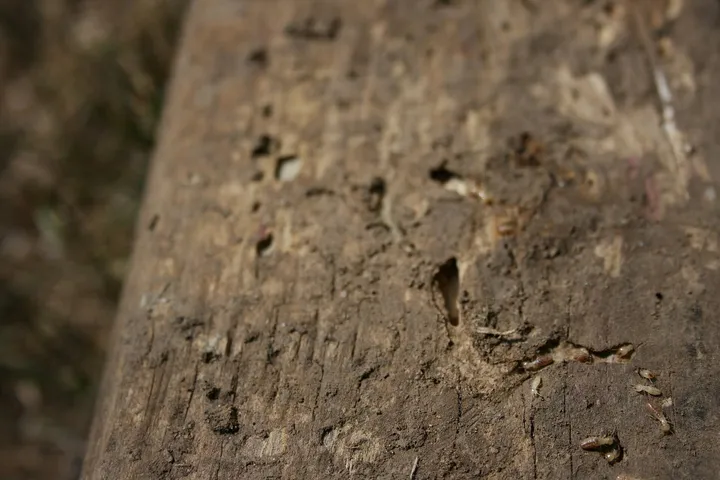

If nothing is found, the inspector checks box A: “No visible evidence of wood destroying insects was observed.” If something is found, box B is checked, and the form warns that “some degree of damage, including hidden damage, may be present.”
The report also lists the areas that could not be inspected, and the recommendations: either no action, or treatment or other action for a named insect.
What it cannot see
This is the part most buyers miss. The form says no inspection is made of anything that would require “breaking apart or into, dismantling, removal of any object.” That covers moldings, floor and wall coverings, siding, fixed ceilings, insulation, furniture, appliances and stored belongings. A crawl space may be listed as inaccessible if the opening is too small or a ladder was needed. The same goes when there is “less than 24 inches of clearance” under the floor joists.
The form’s optional key of obstructions runs to 26 items. They range from finished ceilings and wall coverings to cluttered conditions, rigid foam board, synthetic stucco, spray foam insulation, dense vegetation, wood piles and snow. In a finished basement, a house with foam-board insulation at the foundation or a winter inspection with snow against the walls, much of the foundation may be listed as obstructed.
After the inspection, read Section IV, the list of obstructed and inaccessible areas, as carefully as the findings. Ask for a reinspection if an area is opened up later; the form notes an additional fee may apply.
Do inspectors check every room?
They check every area they can reach, not every surface in every room. The NPMA-33 form limits the inspection to “readily accessible areas.” Its checklist runs by area rather than by room: basement, crawl space, main level, attic, garage, exterior, porch and additions. Anything behind finished walls, under fixed flooring or behind stored belongings stays unseen and goes on the obstructions list.
How to prepare for a termite inspection
Most of the preparation is giving the inspector access. Because the NPMA-33 inspection is visual and nothing is moved or opened, whatever is blocked on the day is simply listed as not inspected. Whether you are the seller or a buyer arranging it with the seller, a week before the visit:
- Open the crawl space. Clear the entrance and the path inside. The form allows a crawl space to be listed as inaccessible if the opening is too small, if a ladder was needed, or with “less than 24 inches of clearance.”
- Clear the basement walls. Pull boxes, shelving and stored items away from the foundation walls and sill so the inspector can see and probe them. The form says no inspection is made where “removal of any object” would be needed, including furniture, appliances and belongings.
- Make the attic hatch reachable, with anything stored beneath it moved aside. The form covers “attics and crawlspaces which permitted entry.”
- Clear the outside of the foundation. Move firewood, wood debris and landscape timbers away from the walls and cut back dense plants. The form lists wood piles and dense vegetation as obstructions, and firewood against the structure, wood mulch touching it and earth-to-wood contact among the conditions that favor infestation. In winter, shovel snow away from the foundation where you can.
- Include every structure. A detached garage, shed or deck may need to be named on the report; tell the company in advance so it is priced and inspected.
- Find the paperwork. Gather records of any past termite treatment, with dates and any service agreement. The form’s guidelines say that if there is evidence of infestation and no previous treatment is documented, treatment should be recommended even when no live termites are seen.
- Leave pets and people out of the way, and plan to be there at the end to hear what was found and what could not be seen.
The CAES termite fact sheet gives the same foundation advice for prevention. Keep wood materials clear of the foundation, use mulch sparingly and not touching siding, and keep plants at least 3 feet away.
How to read the report
- It is a snapshot, not a warranty. The form says it is “indicative of the condition of the above identified structure(s) on the date of inspection.” It “is not to be construed as a guarantee or warranty against latent, concealed, or future infestations.”
- It is not a structural report. “This is not a structural damage report,” and the inspector’s training does “not qualify the inspector in damage evaluation.” If damage is noted, the form recommends a qualified structural professional.
- It expires for closing purposes after 90 days. The report is “invalid for purposes of securing a mortgage and/or settlement of property transfer if not used within ninety (90) days.” That limit “shall not be construed as a 90-day warranty.”
- Treatment recommendations follow set guidelines. If live termites are found, treatment or corrective action should be recommended. If there is evidence of infestation and no record of a previous treatment, treatment should be recommended even when no live termites are seen. That is why a seller’s treatment records matter.
- No conflict of interest. The form states that neither the company nor the inspector has, or plans to have, any interest in the property.
What must Connecticut sellers disclose about termites?
Connecticut does not require sellers to inspect for termites, but it does require them to say what they know. Under CGS 20-327b, a seller of residential property with one to four units must give the buyer a written residential condition report. That includes condominiums and cooperatives, and the report comes before the buyer signs a binder, contract or option. The statutory content includes two questions that matter here:
- “Termite, Insect, Rodent or Pest Infestation problems? If YES, explain:”
- “Rot or Water damage problems? If YES, explain:”
Three limits apply. The seller’s answers extend only to the seller’s “actual knowledge” (20-327e). The law does not require the seller to “secure inspections, tests or other methods of determining the physical conditions of the property” (20-327d). And some transfers are exempt, including those by executors and after foreclosure (20-327b(b)). If a seller who must provide the report does not, the purchase agreement must give the buyer a $500 credit at closing (20-327c(a)). The credit is not a way out of disclosure. Under 20-327c(b), paying it does not excuse a seller from disclosing a defect covered by the report that the seller actually knows about. That applies to a defect that significantly impairs the home’s value, the health or safety of future occupants, or its useful life. Under 20-327c(c), a buyer can sue to recover actual damages from a seller who fails to disclose such a defect.
For buyers, a “yes” to the termite question is a reason to ask for treatment records and order an inspection. For sellers, records of a past treatment and any warranty help answer the question fully.
Who does the inspection
Ask a DEEP-registered pest control company. Connecticut requires every pesticide application business to hold a DEEP registration and to print the number on written contracts, vehicles and newspaper, billboard and directory ads (Connecticut General Statutes, chapter 441). DEEP’s certification category descriptions list category 7B, Termites and WDO Pest Control, for termites and other wood destroying organisms. The NPMA-33 form itself has spaces for the company’s business number and the inspector’s certification or registration number; check that they are filled in.
Two cautions. If the inspecting company also offers to treat, get another opinion before you agree; CAES recommends interviewing several companies before any termite treatment and discarding “extremely high or low quotes.” And termite damage “progresses slowly,” CAES says, so a finding at inspection is a reason to negotiate and plan, not to panic.
How much does a termite inspection cost?
One of the three national cost guides this site uses prices an inspection; the other two do not. Each figure is shown with its publisher and date, and none is a Connecticut price.
| What is priced | Figure | Source |
|---|---|---|
| Termite or other wood-destroying insect inspection | $100 to $290 | Bob Vila, national, as of September 2024 |
| General pest inspection | “about $65 to $135” | Bob Vila, national, as of September 2024 |
| Termite or WDI inspection | This guide found no published figure | This Old House (as of March 2026) and Fixr (as of January 2025) give none |
For context, This Old House prices termite treatment at $250 to $1,000 (national, as of March 2026); treatment is a separate job from the inspection report.
Several things affect the fee: the size of the house and how many structures are on the report (a detached garage or barn counts). Crawl space and attic access matter too, and so does whether a reinspection is included. Ask for the fee in writing, and ask who is paying it: under a VA loan the veteran may be charged, and the circular encourages negotiating with the seller.
Termite inspections in five Fairfield County towns
The Census Bureau’s American Community Survey, 2020–2024 shows how different the housing is across the county:
- Darien has some of the oldest housing in the county, with 56.4% of homes built before 1960 and a median home value of $1,822,400. See pest control in Darien.
- Fairfield has 51.1% of homes built before 1960, and 77.5% are detached single-family houses, with a median home value of $780,500. See pests in Fairfield.
- Westport has the highest share of detached single-family homes of the 10 towns with pages in this guide, 87.7%. See pest control in Westport.
- Stamford is the opposite: only 33.8% of its housing units are detached, so many sales are condominiums, which the seller disclosure law also covers. See pests in Stamford.
- Trumbull sells mostly postwar houses: 44.3% of its homes were built from 1950 to 1969, the highest share of the county’s 23 towns, and the median year built is 1965. Ask the inspector to reach the sill plate and any crawl space. See termite inspection notes for Trumbull’s postwar homes.
If the inspection finds termites, the termite control guide covers treatment options and costs. If it finds carpenter ants, see carpenter ant control and the carpenter ants vs termites guide.
Sources
- National Pest Management Association, NPMA-33 Wood Destroying Insect Inspection Report (hosted by HUD): https://www.hud.gov/sites/dfiles/OCHCO/documents/NPMA33.pdf
- CAES, Eastern subterranean termite fact sheet: https://portal.ct.gov/-/media/CAES/DOCUMENTS/Publications/Fact_Sheets/Entomology/Eastern_Subterranean_Termite_Reticulitermes.pdf
- University of Kentucky Entomology, ENTFACT-616, Powderpost Beetles (revised March 2026): https://entomology.ca.uky.edu/ef616
- HUD, FHA Homeownership Center reference guide (archived): https://archives.hud.gov/offices/hsg/sfh/ref/sfhp1-23.cfm
- US Department of Veterans Affairs, Circular 26-22-11 (June 15, 2022): https://www.benefits.va.gov/HOMELOANS/documents/circulars/26-22-11.pdf
- Connecticut General Statutes, chapter 392 (sections 20-327b to 20-327e): https://www.cga.ct.gov/current/pub/chap_392.htm
- Connecticut General Statutes, chapter 441: https://www.cga.ct.gov/current/pub/chap_441.htm
- CT DEEP, commercial applicator certification category descriptions: https://portal.ct.gov/-/media/deep/pesticides/certification/supervisor/catinfopdf.pdf
- This Old House, pest control cost (national, updated March 2026): https://www.thisoldhouse.com/pest-control/pest-control-cost
- US Census Bureau, ACS 2020–2024 table B25034 (year structure built): https://data.census.gov/api/access/data/table?id=ACSDT5Y2024.B25034&g=040XX00US09$0600000
- US Census Bureau, ACS 2020–2024 table B25077 (median home value): https://data.census.gov/api/access/data/table?id=ACSDT5Y2024.B25077&g=040XX00US09$0600000
- US Census Bureau, ACS 2020–2024 table B25024 (units in structure): https://data.census.gov/api/access/data/table?id=ACSDT5Y2024.B25024&g=040XX00US09$0600000
- Bob Vila, How Much Does Pest Control Cost? (national, updated September 5, 2024): https://www.bobvila.com/articles/pest-control-cost/
- Fixr, How Much Does It Cost To Hire An Exterminator? (national, updated January 31, 2025): https://www.fixr.com/costs/pest-control
- US Census Bureau, ACS 2020-2024 median year structure built (B25035): https://data.census.gov/api/access/data/table?id=ACSDT5Y2024.B25035&g=040XX00US09$0600000
Frequently asked questions
Is a termite inspection required to buy a house in Connecticut?
This guide found no Connecticut law that requires one. It depends on the loan: FHA requires one only in set cases, such as active infestation or when the lender asks; VA requires one in high-probability termite zones; other lenders set their own rules. Ask your lender early, and check your purchase contract.
How long is a termite inspection good for?
For a mortgage or closing, 90 days. The NPMA-33 report, which FHA and VA accept, says it is invalid for securing a mortgage or settling a property transfer if not used within ninety days of the inspection. It adds that this "shall not be construed as a 90-day warranty."
How much does a termite inspection cost?
One national cost guide prices it: Bob Vila puts termite or other wood-destroying insect inspections at $100 to $290 (national, as of September 2024). This Old House and Fixr give no inspection price. The fee usually reflects the size of the house, the number of structures and crawl space access. Ask for it in writing.
How do I prepare for a termite inspection?
Clear the way to the areas the inspector must see. The NPMA-33 form covers only readily accessible areas and says nothing is moved, so pull stored belongings away from basement walls, open the crawl space and attic hatch, and clear wood piles and plants from the foundation. Have past treatment records ready.
Do sellers in Connecticut have to disclose termites?
Sellers of one- to four-unit homes must give buyers a written condition report that asks about "Termite, Insect, Rodent or Pest Infestation problems" (CGS 20-327b), covering what they actually know. Skipping the report means a $500 closing credit, but that credit does not excuse hiding a known defect that significantly impairs value, safety or useful life.
Who pays for a termite inspection on a VA loan?
The veteran may be charged. A 2022 VA circular lets veterans pay the inspection fee where the VA Notice of Value requires a report, and pay required repairs, and it encourages them to negotiate those costs with the seller. Repairs the report requires must be finished before VA guarantees the loan.
What does a termite inspection look for?
Wood destroying insects: termites, carpenter ants, carpenter bees and reinfesting wood boring beetles, according to the NPMA-33 form. The inspector looks for live insects, dead insects, wings, shelter tubes, exit holes, frass and visible damage in accessible areas. Mold, mildew and wood rot are outside its scope.